



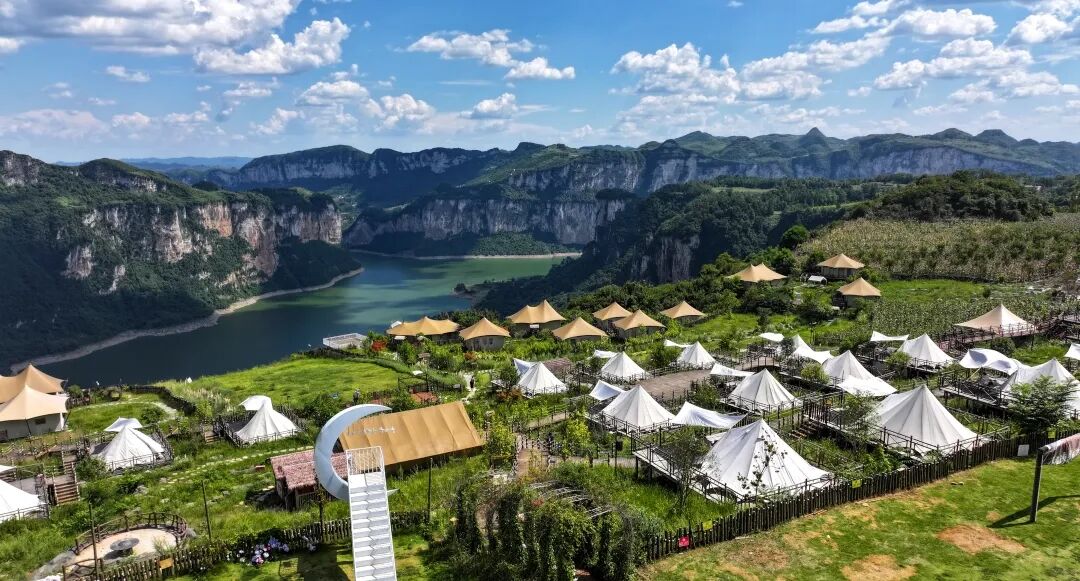
Here, the Liuchong River and Sancha River converge majestically to form the Wujiang River. Here, towering green mountains resemble a roc spreading its wings. Boats sailing on the river tell stories of past and present. Nature wields a giant brush, vividly writing the tale of “breaking free from a cocoon and transforming into a butterfly”. This is Huawu Village, the “village beneath the cliff” in Xinren Miao Township, Qianxi City, Bijie.
For thousands of years, the river and sheer cliffs stood as barriers blocking Huawu villagers’ path out of the mountains. Today, it has transformed into a well-known tourist destination. Silver needles fly swiftly in embroidery workshops, fragrance drifts from farm restaurants, cruise ships cut through waves on the river, and Miao people sing loudly…
In recent years, relying on the provincial intangible cultural heritage “Huawu Miao Cultural Space”, the village has rooted itself in Miao embroidery inheritance and taken ethnic culture as its soul. It promotes the in-depth integration of intangible heritage craftsmanship with cultural tourism, reviving this ancient ethnic culture amid mountains and rivers, and blazing a path of rural revitalization where culture fuels the transformation of “lucid waters and lush mountains into invaluable assets”.
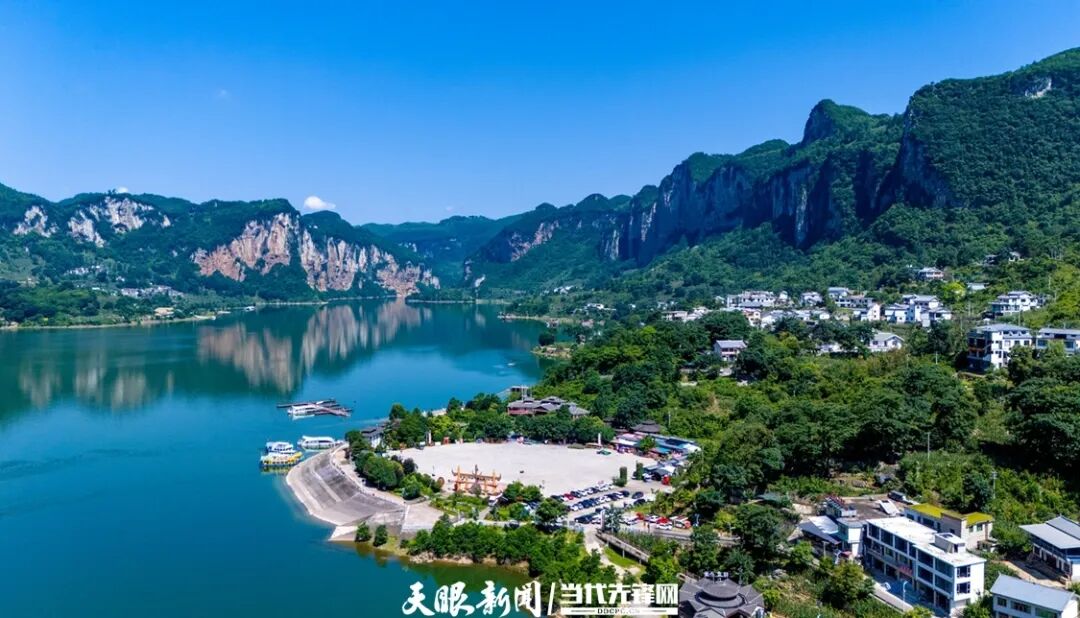
Summer scenery of the Wujiang River Source Hundred-Mile Gallery in Huawu Village, Xinren Township, Qianxi City, Bijie. Photo by Chen Ying
Preserving Cultural Roots Stitch by Stitch
Stepping into the village’s Miao batik and embroidery workshop, shelves are filled with costumes, bags, book covers and other items embroidered with Miao cultural motifs, dazzling visitors. Workshop director Yang Wenli sorts cultural and creative products while introducing new handbags to tourists.
“I learned Miao embroidery stitches from elders when I was young. I deeply understand the ethnic heritage woven into this craft.” The 31-year-old Yang Wenli is a local inheritor of Miao batik and embroidery, as well as a leader lifting villagers out of poverty. With ancestral craftsmanship, she united fellow villagers to develop the Miao embroidery industry and increase their incomes.
In 2017, after years of working away from home, Yang Wenli returned to her hometown to start a business and founded Qianxi Wenli Batik and Embroidery Co., Ltd. Her product line expanded from simple embroidered patches at first to sachets, embroidered costumes and cultural and creative goods. Thanks to her efforts, Huawu Miao embroidery sells well across the country online.
Stitch by stitch, cultural roots are preserved; stroke by stroke, a better life is depicted. Drawing on profound ethnic cultural heritage, Huawu Village has vigorously advanced integrated cultural and tourism development in recent years, using culture to nurture tourism and tourism to showcase culture, boosting comprehensive rural revitalization. Since 2021, the village has organized training sessions, expanding the group of embroidery craftswomen to over 60. The annual output value of the Miao embroidery industry has exceeded 3 million yuan.
“In the past, blocked by poor transport, this delicate handcraft was only used for wedding garments and daily clothes, hidden deep in mountains and unknown to outsiders,” said Xiao Yangqun, Party Branch Secretary of Huawu Village. Now that the village has gained popularity, Miao batik and embroidery has stepped “out of seclusion”.
While the TV drama Deep in the Wumeng Mountains was filmed in Huawu Village, Yang Wenli, the prototype for the heroine Gun Yueliang, took part in the whole creation guidance, standardizing Miao embroidery patterns and ethnic etiquette details. Through television screens, audiences nationwide gained deeper understanding of the ethnic culture in the Wumeng Mountains, and Huawu’s Miao embroidery industry took off riding this momentum.
It is reported that after the drama aired, the average daily number of visitors to the workshop jumped from 30–40 to more than 200, peaking at over 500 on holidays. Orders for Miao embroidery rose by more than 10% year-on-year. In 2025, the workshop achieved sales of 3.86 million yuan. The once “pastime craft” has become a fingertip economy enriching local residents.
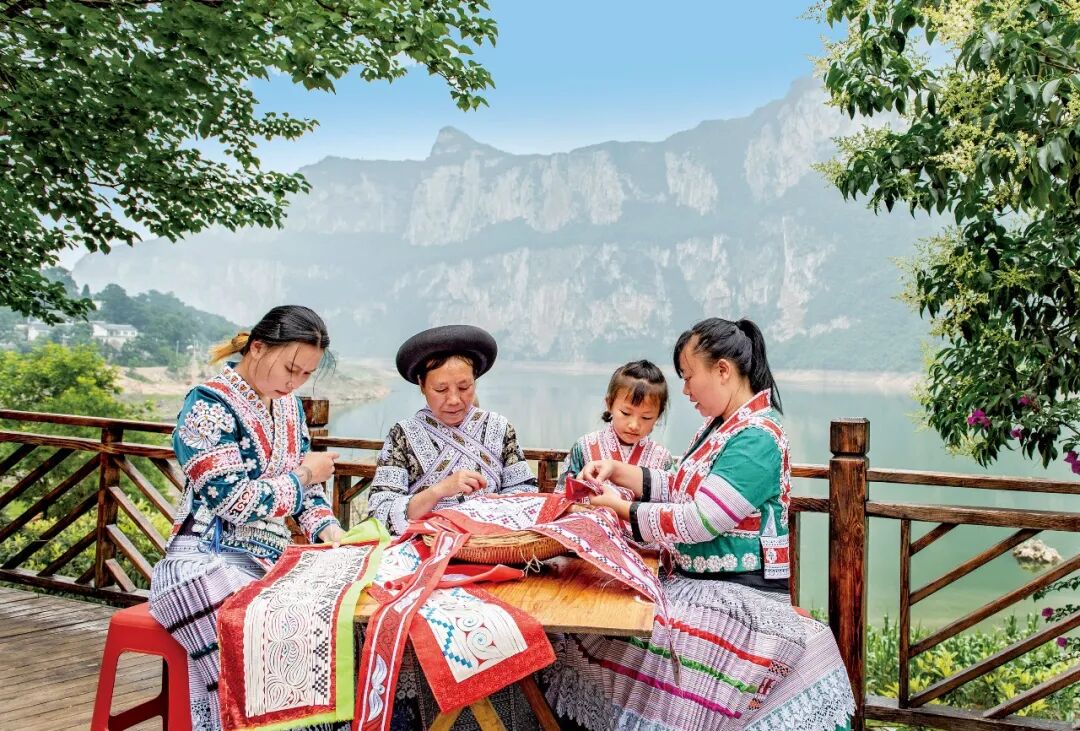
Yang Guomei and her family from Huawu Village, Xinren Township, Qianxi City, Bijie, doing embroidery near their home in spare time. Photo by Luo Xingxiang (Image Guizhou)
Improved Transport Activates Cultural IP
In the old days, there were two ways to leave Huawu Village. One was to take wooden boats along the waterway to Yachi River; the other was to climb steep cliffs clinging onto rock surfaces. Those rough roads troubled generations of Huawu people.
Good roads bring prosperity to all industries. In 2007, with assistance from the Central Committee of the China National Democratic Construction Association, a hardened road was built in the village. In 2017, village and group roads reached residents’ doorsteps. In 2022, the tourist highway linking Xinren Toll Station to Huawu opened to traffic, further opening the main artery for cultural tourism development.
With improved transportation, the landscape of the Wujiang River Source Hundred-Mile Gallery blends with profound Miao culture, bringing Huawu Village a golden opportunity for cultural tourism growth. Moving beyond simple sightseeing, the locality embeds Miao culture into the whole tourism chain, allowing visitors to admire mountain and river scenery, experience Miao life and appreciate the charm of intangible heritage.
“Our forefathers ferried people out on small wooden boats, and now large cruise ships carry tourists for sightseeing,” recalled You Rongxue, General Manager of Qianxi Gallery Shipping Co., Ltd. After returning to start a business in 2016, he and his two elder brothers purchased two sightseeing cruise ships and built a livelihood in tourism against all odds.
Over the past decade, he has integrated Miao toast songs and folk tales into cruise commentary, turning every voyage into a mobile classroom of Miao culture. During peak seasons, he makes five round trips per day with daily turnover reaching tens of thousands of yuan. He has renovated his house to build the homestay “Old Apricot Tree Residence”, with a restaurant on the ground floor and guest rooms upstairs. From the windows, visitors overlook the blue waves of the Wujiang River. The blend of ethnic customs and natural scenery has made it a popular check-in spot.
Villager Zhao Yuxue’s farmhouse has become a cultural tourism landmark of Huawu Village. His brand “Zhao Yuxue Yellow Cake” turns traditional yellow cake craftsmanship into distinctive cultural tourism products, and boxed yellow cakes are must-buy souvenirs for tourists. The farmhouse serves delicacies including Miao spicy chicken and Wujiang fish, with annual revenue exceeding 100,000 yuan. Whenever tourists come, he warmly tells them about the village’s transformation and shares the warm stories embedded in Miao food culture.
As cultural tourism formats keep expanding, the village now hosts 41 farmhouses and 27 boutique homestays. New business forms including wild camping, mountain sports and immersive folk custom experiences have taken root.
Leveraging the IP of Deep in the Wumeng Mountains, the village restored drama shooting sites and launched interactive activities such as Miao embroidery experience, batik making and agricultural study tours. Simple landscape sightseeing has upgraded to in-depth cultural experience tourism. Over the past year, the village received more than 500,000 visitors in total, with comprehensive tourism revenue exceeding 100 million yuan, and the effects of culture-driven development keep releasing.
Cultural-Tourism Integration Paints a Beautiful Harmonious Village
“The spring breeze blows over Huawu Village; the Party is closely linked with us. Huawu has witnessed tremendous changes, and we sing folk songs for the Party.” Yang Mei, a Miao senior teacher over 70 years old, wrote this grateful and uplifting folk song. She holds deep affection for Miao folk songs: “As early as 1993, our village was named a Hometown of Miao Songs and Dances by Guizhou Provincial Department of Culture and Tourism.” Today, the village has formed an art troupe to stage Miao singing and dancing performances regularly in tourist seasons, letting Miao folk songs echo along both banks of the Wujiang River.
“Previously we remained poor trapped in mountains, but now we live on tourism relying on cultural treasures left by our ancestors. Such a good life was beyond our imagination,” Yang Mei said with emotion. Over these years, she has witnessed continuous improvement of infrastructure: sewage pipelines, cultural squares and lighting projects have been upgraded, greatly lifting the living environment.
The village Party committee and village committee have built skill training platforms, holding special sessions on homestay operation and catering services. More than 80 households have launched their own businesses. The “Three Yellow” characteristic industries (yellow cake, yellow cattle and yellow ginger) are closely integrated with cultural tourism, helping local agricultural specialties go out of mountains. Within five years, Huawu Village received over 3 million visitors in total, and per capita disposable income rose from 11,500 yuan in 2020 to 33,500 yuan in 2025.
The Wujiang River flows endlessly, witnessing the passage of time. From an isolated “cliff island” to a famous cultural tourism village; from nearly lost folk crafts to a nationally renowned intangible heritage IP, Huawu Village inherits cultural heritage stitch by stitch, and activates the surging vitality of development through cultural-tourism integration.